
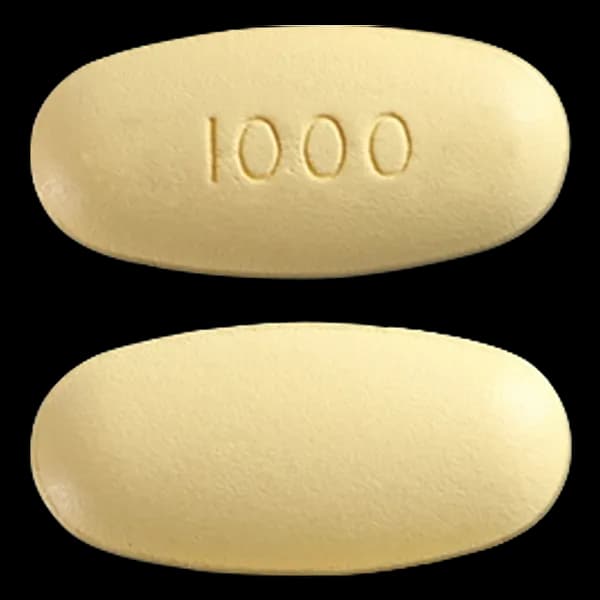
Showing the 1000mg medicine. Other strengths look different — the picture changes with the strength you select.
Generic Ranexa
Active ingredient: Ranolazine
$28.20
In stock (100 available)
A prescription is required
You can add this to your basket, but we cannot dispense it until you upload a valid prescription at checkout and our registered pharmacist approves it. Your card is authorized but not charged until then.
About this medicine
What it is used for
1 INDICATIONS AND USAGE Ranolazine extended-release tablet is indicated for the treatment of chronic angina. Ranolazine extended-release tablet may be used with beta-blockers, nitrates, calcium channel blockers, anti-platelet therapy, lipid-lowering therapy, ACE inhibitors, and angiotensin receptor blockers. Ranolazine extended-release tablet is an antianginal indicated for the treatment of chronic angina. ( 1 )
How it is taken
2 DOSAGE AND ADMINISTRATION 500 mg twice daily and increase to 1000 mg twice daily, based on clinical symptoms ( 2.1 ) 2.1 Dosing Information Initiate ranolazine extended-release tablet dosing at 500 mg twice daily and increase to 1000 mg twice daily, as needed, based on clinical symptoms. Take ranolazine extended-release tablet with or without meals. Swallow ranolazine extended-release tablet whole; do not crush, break, or chew. The maximum recommended daily dose of ranolazine extended-release tablet is 1000 mg twice daily. If a dose of ranolazine extended-release tablet is missed, take the prescribed dose at the next scheduled time; do not double the next dose. 2.2 Dose Adjustments in Specific Populations Dose adjustments may be needed when ranolazine extended-release tablet is taken in combination with certain other drugs [see Drug Interactions (7.1) ] . Limit the maximum dose of ranolazine extended-release tablet to 500 mg twice daily in patients on moderate CYP3A inhibitors such as diltiazem, verapamil, and erythromycin. Use of ranolazine extended-release tablet with strong CYP3A inhibitors is contraindicated [ see Contraindications (4) , Drug Interactions (7.1) ] . Use of P-g
Warnings
5 WARNINGS AND PRECAUTIONS QT interval prolongation: Can occur with ranolazine. Little data available on high doses, long exposure, use with QT interval-prolonging drugs, potassium channel variants causing prolonged QT interval, in patients with a family history of (or congenital) long QT syndrome, or in patients with known acquired QT interval prolongation. ( 5.1 ) Renal failure: Monitor renal function after initiation and periodically in patients with moderate to severe renal impairment (CrCL<60 mL/min). If acute renal failure develops, discontinue ranolazine. ( 5.2 ) 5.1 QT Interval Prolongation Ranolazine blocks IKr and prolongs the QTc interval in a dose-related manner. Clinical experience in an acute coronary syndrome population did not show an increased risk of proarrhythmia or sudden death [see Clinical Studies (14.2) ] . However, there is little experience with high doses (>1000 mg twice daily) or exposure, other QT-prolonging drugs, potassium channel variants resulting in a long QT interval, in patients with a family history of (or congenital) long QT syndrome, or in patients with known acquired QT interval prolongation. 5.2 Renal Failure Acute renal failure has been obse
Source: openFDA / DailyMed. Provided for information only — always follow the directions given by your own prescriber.